
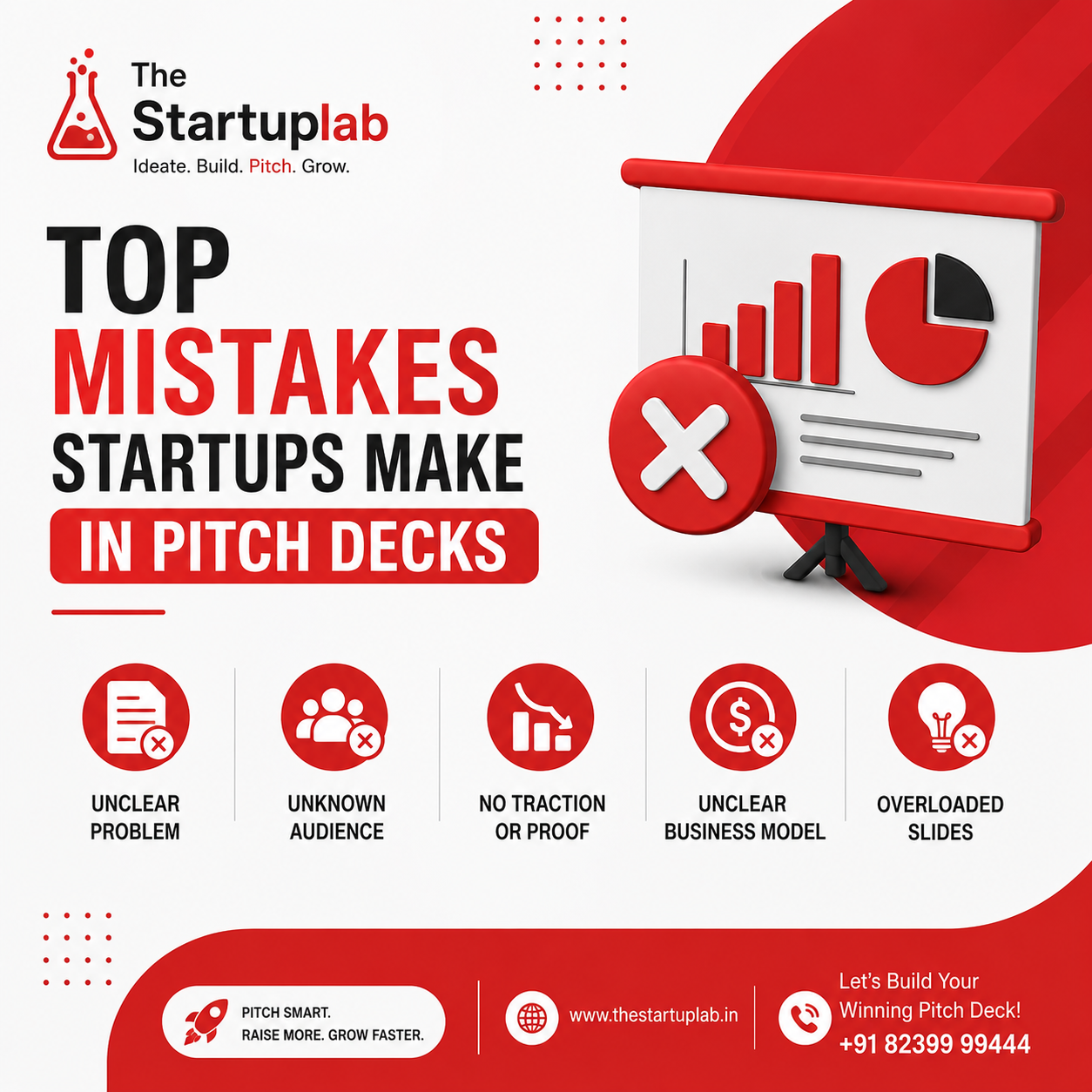
Why Most Startup Pitch Decks Fail to Impress Investors
Raising startup funding is not only about having a great idea.
It is about communicating:
- the opportunity,
- the market,
- the business model,
- and the scalability
in a way investors immediately understand.
Most startup pitch decks fail not because the business is weak —
but because the communication is weak.
Investors review hundreds of startup decks every month.
If your pitch deck is:
- confusing,
- too technical,
- poorly structured,
- or lacks investor clarity,
it gets ignored quickly.
In this guide, we explain the most common pitch deck mistakes startups make and how founders can create investor-ready presentations that improve fundraising opportunities.
Why Pitch Decks Matter in Startup Fundraising
A startup pitch deck is often the first impression investors have about:
- your business,
- your thinking,
- your market understanding,
- and your execution capability.
A strong pitch deck can:
- open investor meetings,
- improve fundraising conversations,
- increase startup credibility,
- and support valuation discussions.
A weak pitch deck can:
- create confusion,
- reduce investor confidence,
- and kill funding opportunities before meetings even begin.
Mistake 1 — Too Much Information
One of the biggest mistakes startups make is overloading slides with too much information.
Founders often try to explain:
- every feature,
- every technical detail,
- every process,
- and every business insight.
But investors do not want information overload.
They want:
- clarity,
- simplicity,
- and structured thinking.
Why This Hurts Investor Attention
Complicated slides:
- reduce readability,
- confuse investors,
- and weaken storytelling.
Good pitch decks simplify complexity.
The goal is not to explain everything.
The goal is to make investors want the next meeting.
Mistake 2 — Weak Problem Statement
Many startups fail to clearly explain:
- what problem exists,
- why it matters,
- and why the market cares.
If the problem is weak:
- the opportunity feels weak,
- the business model feels weak,
- and the startup loses urgency.
What Investors Want to See
Investors want to understand:
- how painful the problem is,
- how large the market opportunity is,
- and why customers need the solution now.
Strong pitch decks create emotional and commercial clarity around the problem.
Mistake 3 — No Clear Business Model
Many startup decks explain the product but fail to explain:
- how the company makes money,
- how revenue scales,
- and why the economics work.
This is one of the fastest ways to lose investor confidence.
Investors Analyze:
- pricing model,
- margins,
- customer acquisition,
- retention,
- scalability,
- and recurring revenue potential.
A beautiful product without a scalable business model rarely attracts investment.
Mistake 4 — Unrealistic Financial Projections
Another common startup mistake is creating unrealistic financial forecasts.
Examples:
- “₹100 crore revenue in 2 years”
- “1 million users in 12 months”
- “profitability immediately after launch”
without logical assumptions.
Investors immediately identify unrealistic numbers.
What Strong Financial Projections Include
Professional investor-ready projections include:
- realistic growth assumptions,
- CAC,
- LTV,
- burn rate,
- runway,
- revenue models,
- and operational scalability.
Good financial models increase investor trust.
Mistake 5 — Poor Market Research
Many startups claim:
- “Huge market opportunity”
without real market understanding.
Investors expect:
- TAM,
- SAM,
- SOM,
- market trends,
- industry growth,
- and competitive positioning.
Weak market research makes the startup appear immature.
Mistake 6 — Weak Design & Presentation Structure
Investors judge startup quality based on presentation quality.
Poor pitch deck design creates signals like:
- lack of professionalism,
- lack of preparation,
- weak communication,
- and poor attention to detail.
Common Design Problems
Too much text
Slides become unreadable.
Poor visual hierarchy
Important information gets lost.
Inconsistent formatting
The deck feels unprofessional.
Weak data visualization
Charts and metrics become confusing.
Good Pitch Deck Design Should:
- simplify information,
- improve readability,
- guide investor attention,
- and support storytelling.
Mistake 7 — Ignoring Competition
Some founders say:
“We have no competitors.”
This is a major red flag.
Every business competes with:
- existing companies,
- alternatives,
- customer behavior,
- or current workflows.
Investors Want:
- competitive awareness,
- positioning clarity,
- differentiation,
- and market understanding.
Strong startups explain:
- why they are different,
- why they can win,
- and why their positioning matters.
Mistake 8 — No Traction or Validation
Investors want evidence that:
- customers care,
- users engage,
- or demand exists.
Without traction, startups appear risky.
Examples of Traction:
- revenue growth,
- active users,
- partnerships,
- customer retention,
- waitlists,
- pilot programs,
- or product adoption.
Even early-stage validation improves investor confidence significantly.
Mistake 9 — Weak Storytelling
The best pitch decks are not random slides.
They are structured fundraising stories.
Investors should clearly understand:
- The problem
- The opportunity
- The solution
- Why now
- Why your startup
- Why your team can execute
Weak storytelling creates confusion and reduces investor engagement.
Mistake 10 — No Clear Funding Ask
Many startups forget to clearly explain:
- how much funding they need,
- how the funds will be used,
- and what milestones the funding achieves.
Investors Expect:
- funding amount,
- runway planning,
- growth allocation,
- hiring plans,
- product development plans,
- and scalability roadmap.
A vague funding ask weakens fundraising discussions.
What Investors Actually Look for in Pitch Decks
Investors evaluate:
- founder clarity,
- scalability,
- execution capability,
- financial understanding,
- market size,
- and long-term potential.
Modern investors want:
- structured thinking,
- data-backed assumptions,
- and realistic growth narratives.
How Professional Pitch Deck Consultants Help
Professional pitch deck consultants help startups:
- structure investor narratives,
- simplify complex ideas,
- improve financial projections,
- enhance design quality,
- and increase fundraising readiness.
Professional support often helps startups:
- improve investor meetings,
- reduce communication gaps,
- and present stronger business positioning.
Why Startups Choose The Startup Lab
The Startup Lab helps startups build investor-ready fundraising documents including:
- Startup Pitch Decks
- Financial Models
- Startup Valuation Reports
- Investor Data Rooms
- Due Diligence Preparation
- Fundraising Strategy Support
The Startup Lab works with:
- early-stage startups,
- growth-stage startups,
- founders,
- accelerators,
- and investor-focused businesses.
Future of Pitch Decks in 2026
Fundraising is becoming:
- more competitive,
- more data-driven,
- and more investor-focused.
Modern pitch decks now require:
- strong storytelling,
- financial clarity,
- AI positioning,
- market defensibility,
- and scalable business thinking.
Founders who communicate clearly gain a major fundraising advantage.
FAQs
What is the biggest mistake in startup pitch decks?
The biggest mistake is lack of clarity. Most decks overload information instead of simplifying the business opportunity.
How many slides should a startup pitch deck have?
Most investor pitch decks perform best between 10–15 slides depending on startup stage and complexity.
Do investors care about pitch deck design?
Yes. Poor design reduces professionalism and investor confidence.
What financials should be included in a pitch deck?
Startups should include:
- revenue projections,
- burn rate,
- runway,
- CAC,
- LTV,
- and growth assumptions.
Should startups hire pitch deck consultants?
Professional consultants help improve:
- storytelling,
- investor positioning,
- financial clarity,
- and presentation quality.