
LLP to Pvt Ltd Company in India: Convert or Start Fresh? A Simple Tax & Legal Guide You can’t miss
As your business grows, many founders reach a common crossroads during LLP to Pvt Ltd company registration in India:
Should you convert your LLP to Pvt Ltd Company, or register a fresh Pvt Ltd company?
Both options are legally valid under company incorporation in India, but the right decision depends on tax impact, compliance burden, funding plans, and future scalability. This guide explains LLP to Pvt Ltd conversion vs fresh private limited company registration in India in simple terms—so you can choose confidently.
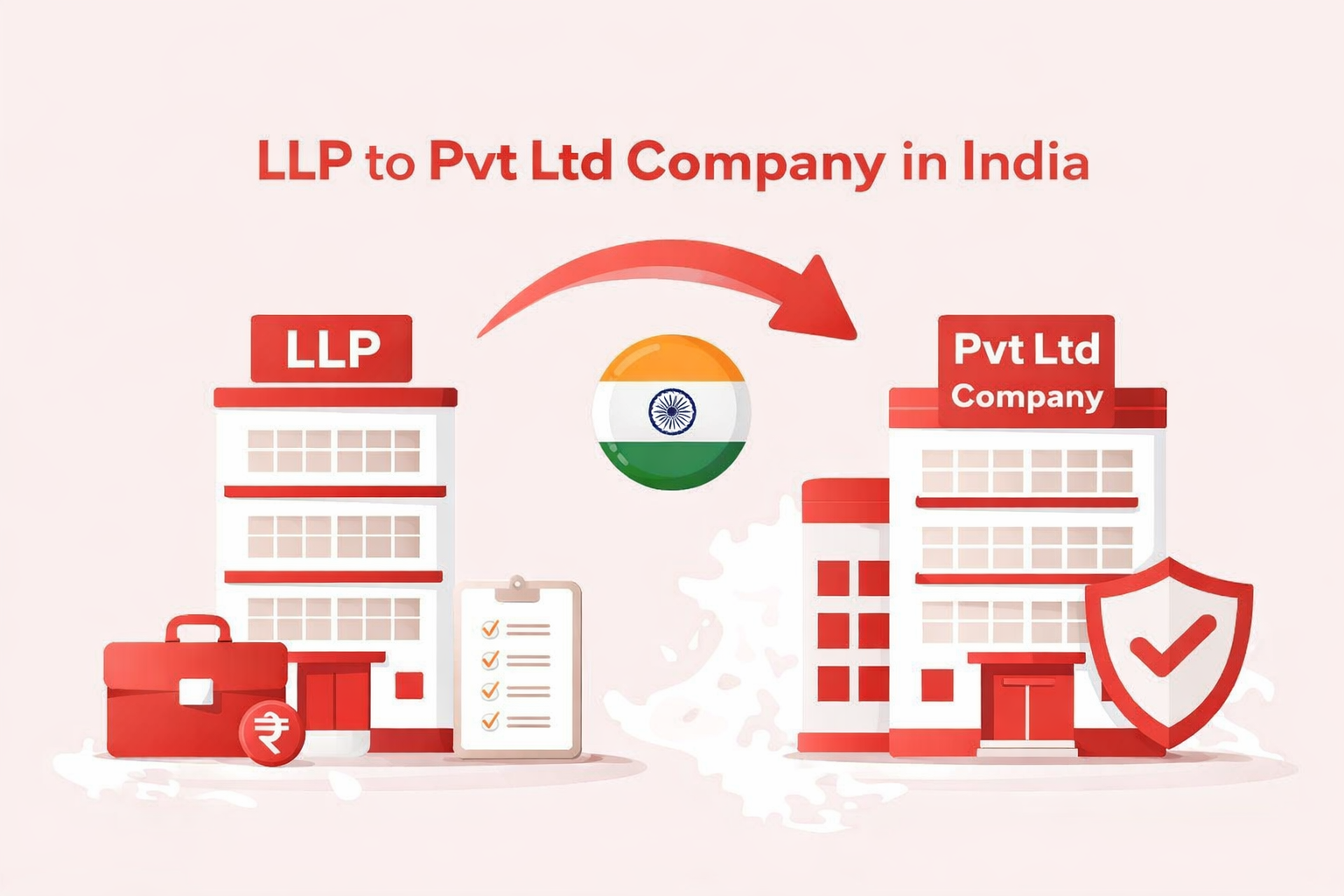
Understanding the Two Options for Company Formation in India
1. Converting an LLP into a Private Limited Company
LLP to Pvt Ltd conversion is a structured legal process under the Companies Act, 2013. Businesses that already completed LLP registration in India often choose this route when they plan to scale.
What happens during conversion:
- All assets, liabilities, and contracts transfer automatically
- LLP partners become shareholders
- Business history and continuity are preserved
- If conditions are met, no capital gains tax applies
This structure is preferred for businesses planning fundraising, ESOPs, or institutional investment, which usually require private limited company registration in India.
2. Starting a Fresh Private Limited Company
In this option, you register a new company through online company registration in India using the SPICe+ process.
How it works:
- A new Pvt Ltd is incorporated from scratch
- LLP remains a separate entity (or is closed later)
- Assets, GST, licenses, and contracts must be transferred manually
This route is often chosen by founders who want a clean slate or are planning startup registration in India under the
Startup India scheme.
Tax Impact: The Biggest Difference
Tax Benefits of LLP to Pvt Ltd Conversion
If conversion complies with Section 47(xiiib) of the Income Tax Act:
- No capital gains tax on asset transfer
- Partners must receive at least 90% shareholding
- Shareholding ratio must match LLP ownership
- No cash payout allowed
- Business must continue for 5 years
Bonus advantage:
Accumulated losses and depreciation of the LLP can be carried forward to the Pvt Ltd.
Tax Risks in Conversion
- Missing any condition triggers capital gains tax
- Cash withdrawal becomes taxable
- Tax authorities closely scrutinise conversions
- Pvt Ltd corporate tax rates apply immediately
- Stamp duty may apply (state-specific)
Tax Benefits of a Fresh Pvt Ltd
- Clean legal and tax history
- No exposure to old LLP notices or disputes
- Freedom to design shareholding and ESOPs from day one
- Easier compliance alignment with startup advisory services
Tax Costs of a Fresh Start
- Asset sale may attract:
- Capital gains tax
- GST (18%)
- Stamp duty
- LLP losses cannot be carried forward
- Dual compliance cost until LLP is closed
Legal & Compliance Comparison
LLP to Pvt Ltd Conversion – Pros
- Contracts and employees move automatically
- Existing registrations remain valid
- Stronger credibility for banks and investors
- Easier transition to ESOP structuring services
LLP to Pvt Ltd Conversion – Cons
- Time-consuming (6–9 months)
- NCLT approvals and creditor notices
- Higher ROC and statutory compliance
- Less flexibility than LLP profit sharing
Fresh Pvt Ltd Registration – Pros
- Fast company registration in India (2–7 days)
- No NCLT involvement
- Flexible MoA, AoA, and equity structure
- LLP liabilities remain isolated
Fresh Pvt Ltd Registration – Cons
- Need fresh GST, bank account, and licenses
- Contracts must be re-signed
- LLP still needs annual compliance
- Separate payroll and statutory filings like ESI & EPF filing
LLP to Pvt Ltd vs Fresh Pvt Ltd: Quick Comparison
| Aspect | LLP to Pvt Ltd Conversion | Fresh Pvt Ltd |
| Tax on asset transfer | Nil (if conditions met) | Applicable |
| Setup time | 6–9 months | 2–7 days |
| Business continuity | Seamless | Manual |
| Compliance burden | High | Moderate |
| Cost | ₹2–5 lakh | ₹1–3 lakh + taxes |
| Best for | Scaling & funding | Clean restart |
Which Option Should You Choose?
Choose LLP to Pvt Ltd Conversion if:
- LLP is compliant
- Partners agree on equity
- You plan funding, ESOPs, or valuation
- You want tax-efficient company formation in India
Choose Fresh Pvt Ltd if:
- LLP has legal or tax issues
- Business model is changing
- You want flexible equity splits
- LLP is small or inactive
FAQs: LLP to Pvt Ltd & Company Registration in India
Is LLP to Pvt Ltd conversion tax-free?
Yes, if Section 47(xiiib) conditions are met. Any violation triggers capital gains tax.
Which structure is better for investors?
Investors prefer Private Limited Companies due to equity clarity, ESOPs, and governance.
Can LLP losses be carried forward?
Yes, if conversion conditions are fulfilled.
Is fresh company registration in India easier?
Yes. It’s faster but may involve higher tax and compliance costs later.
Do startups need additional compliance?
Yes. Startups also need GST, ROC filings, accounting, and sometimes financial modeling or data room setup for fundraising.
Final Word
Choosing between LLP conversion and fresh company registration in India is a strategic decision.
- A CA must evaluate tax eligibility
- A CS must handle ROC and NCLT filings
- Poor structuring can cost lakhs later
The right choice today supports smoother funding, compliance, and long-term growth. Decide based on where your business is headed, not just what feels easier today.